What replaces Microsoft Viva Topics?
Microsoft has discontinued Viva Topics, and there is no direct successor. The ability to build topic pages automatically from existing documents is partly taken over by Microsoft Copilot and SharePoint search. What Viva Topics could never do, Copilot does not cover either: experiential knowledge that is documented nowhere. Anyone who mainly needs that knowledge available needs a way to capture it from people before an AI can answer on it.
- Viva Topics was a good idea. Knowledge from existing content, right in the flow of work.
- Its limit was the unwritten. Around 80% of critical knowledge is in no document.
- Copilot is enough if documentation is good. Otherwise the knowledge has to be captured first.
Viva Topics was a good idea. That is worth saying before talking about successors. Instead of writing knowledge into a wiki by hand, an AI scanned existing documents in Microsoft 365, recognised topics, people and projects and built topic pages from them. Anyone who came across a technical term in a text saw a card with an explanation, contacts and relevant files. For many companies this was the first attempt to run knowledge management as something other than a maintenance chore.
Microsoft has discontinued the product (announced in February 2025). Whoever rolled it out now faces the question of what takes its place.
What Viva Topics did well
The approach had two real strengths. It used content that already existed, and it brought knowledge to where work happened, in Outlook, Teams and SharePoint, rather than into a separate portal. Both are points where classic wikis still fail today.
Anyone who used Viva Topics seriously also learned something about their own organisation: how many topic pages stayed empty because there simply were no documents for a term.
Where the approach hit its limit
That was exactly the limit. Viva Topics could only condense what had been written down. According to McKinsey, however, around 80% of business-critical knowledge is implicit, in people's heads rather than in documents. A topic page on line 4 showed the maintenance manual, but not that you should call the colleague from the early shift when you hear a particular noise.
Then there was maintenance. The automatically generated pages had to be reviewed and curated, and in many companies that work fell to a few committed people. Where they were missing, outdated pages piled up and were displayed with great confidence.
The obvious answer: Copilot
For many organisations the de facto successor is Microsoft Copilot. It searches the same content, answers questions in natural language and is part of the licence conversation anyway. If your knowledge is well documented, kept current and stored in Microsoft 365, that is a sensible solution, and there is little reason to introduce another system.
The underlying problem stays the same as with Viva Topics, just better phrased. Copilot answers on the basis of what it finds. Where nothing is written, it answers anyway, with whatever looks most similar. For knowledge that was never written down, that is the riskiest spot.
The other answer: capture first, then provide
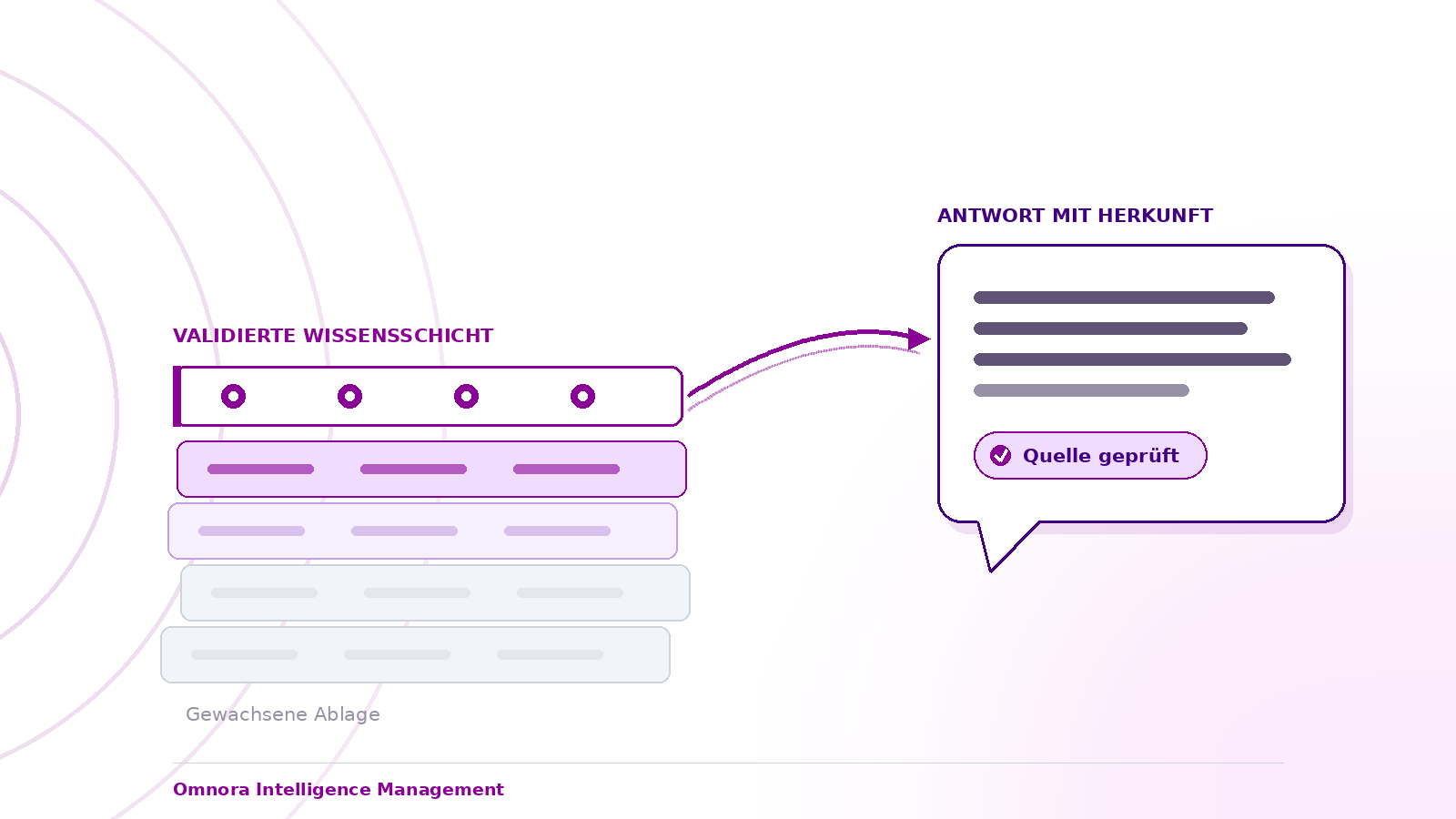
Anyone who still remembers the empty topic pages knows the real gap. It is not closed by better search but by the missing knowledge coming into existence in the first place. That means the people who hold it are asked specifically, the answers are verified and given an owner, and only then are they available to search, chat or training. An AI-guided interview needs around 30 minutes of expert time for this. How that works is described in the piece on AI expert interviews.
Why a wiki does not close this gap either is covered in the piece on the Confluence alternative.
How to tell which direction is right
A simple test: take the ten topic pages that were opened most often in your Viva Topics. If they were full because good documents existed, Copilot is probably enough. If they were thin even though everyone knew whom to ask about the topic, the problem lies elsewhere.
How Omnora provides verified experiential knowledge as context for your AI, with source and owner.
Corporate brain →Häufige Fragen
Is there an official successor to Viva Topics?
No. Microsoft has discontinued Viva Topics (announced February 2025). Parts of the functionality are covered by Microsoft Copilot and SharePoint search, but there is no equivalent replacement for automatically generated topic pages.
Is Microsoft Copilot enough as a replacement?
Often yes, if your knowledge is well documented, current and stored in Microsoft 365. For experiential knowledge that is written down nowhere, Copilot does not help, because it can only access existing content.
Why did many topic pages in Viva Topics stay empty?
Because Viva Topics could only condense what was documented. According to McKinsey, around 80% of business-critical knowledge is implicit and sits in people's heads rather than in documents.
How can undocumented knowledge be made available?
By capturing it from the people who hold it, for instance in AI-guided interviews of around 30 minutes. The answers are verified, assigned an owner and then provided for search, chat and training.
Is a wiki an alternative to Viva Topics?
Only for knowledge someone is willing and able to write down. A wiki does not close the gap that became visible with Viva Topics either, because it depends on the same documentation work.
Quellen
- Microsoft: Discontinuation of Viva Topics, announced February 2025 [Vendor statement]
- McKinsey: Share of implicit, business-critical knowledge [Study]
- Omnora: around 30 minutes of expert time per AI interview [Omnora field value]